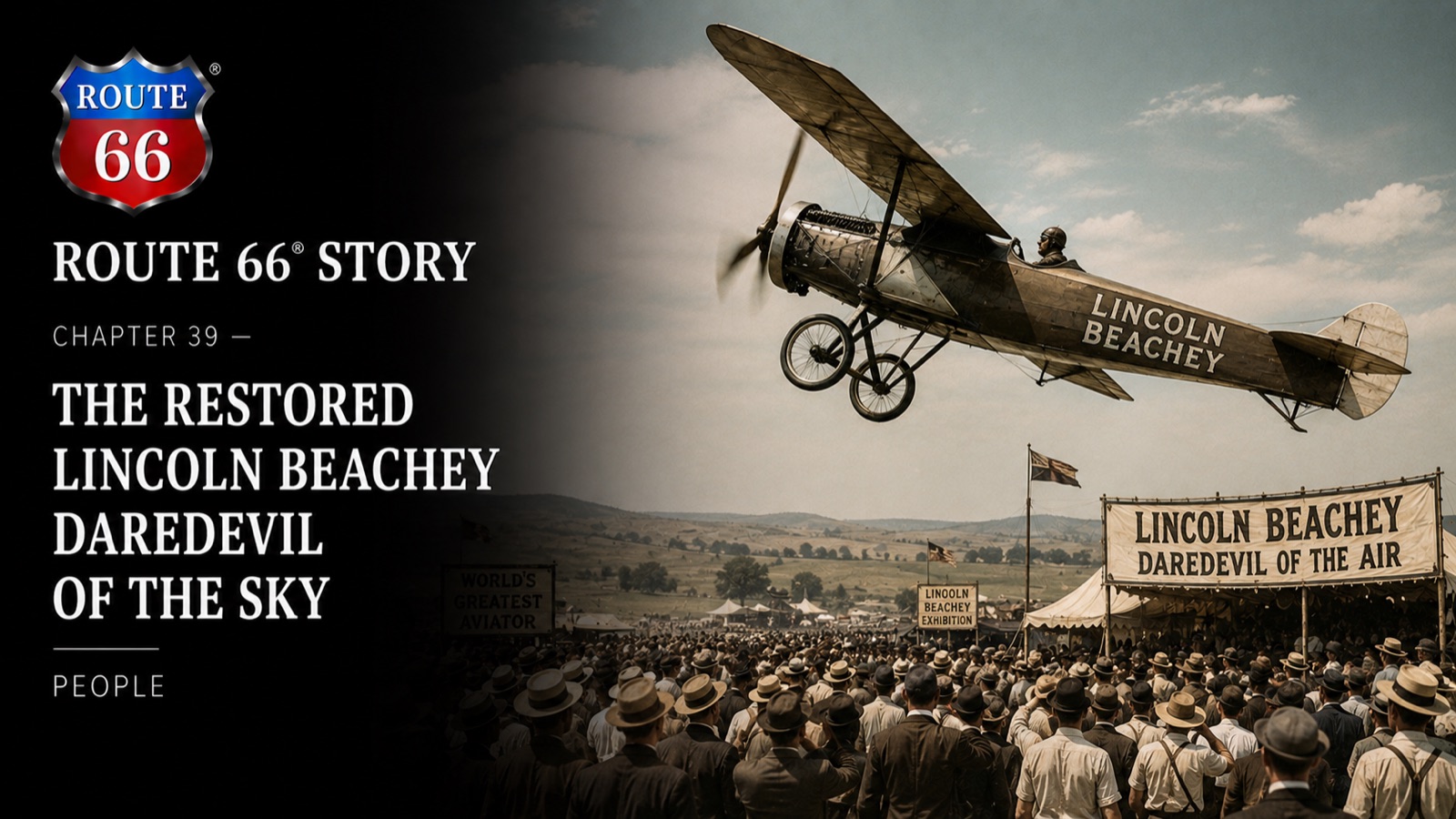
Chapter 39 — The Restored Lincoln Beachey Daredevil of the Sky
Before there was a Mother Road, there was the same restless American hunger for speed and spectacle that would one day fill it — and in the years just before Route 66 was born, few embodied that hunger more than Lincoln Beachey.
Beachey was the most famous stunt pilot in America, a man who threw his flimsy early aircraft into loops and dives that crowds of tens of thousands paid to gasp at. He flew indoors. He raced automobiles from the air. He pioneered maneuvers later pilots would build careers on. Then, on March 14, 1915, at the Panama-Pacific International Exposition in San Francisco, he pushed a brand-new monoplane into a steep dive, the wings folded under the strain, and he plunged into the Bay in front of a horrified crowd. He was twenty-eight.
His connection to Route 66 is honestly more spirit than fact — he flew in California, not down a highway that did not yet exist. But he belongs to the same American moment: the early twentieth century’s giddy, dangerous love affair with machines and motion and the thrill of going faster than was strictly wise. That same impulse, a decade later, would put a nation behind the wheel and send it barreling west on a two-lane road.
Beachey chased the horizon straight up. Route 66 would let everyone else chase it sideways.
We are offering licences for ROUTE 66® Beer in specific territories. An invitation to others to become part of this story. To carry a piece of the road with them and to contribute to the story. We will share a percentage of royalties with Route 66 associations to keep the story alive.
BY ENTERING THIS WEBSITE YOU MUST BE AND CONFIRM THAT YOU ARE OF LEGAL DRINKING AGE IN THE COUNTRY THAT YOU ARE IN AND LEGALLY PERMITTED TO VIEW THESE PAGES.
This info is all part of our commitment to responsible drinking.