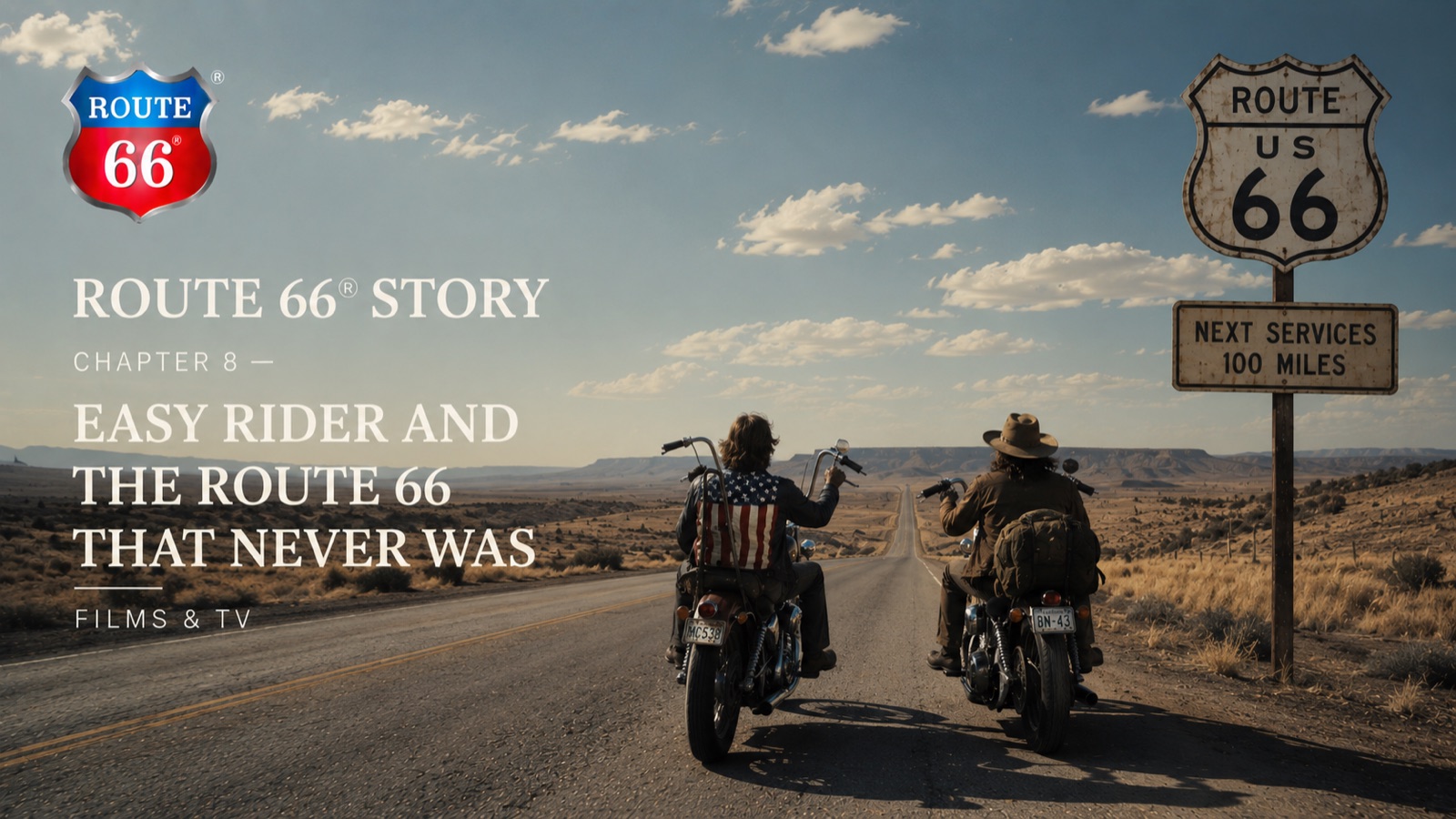
Easy Rider came out in 1969 and told the story of two motorcyclists riding from Los Angeles to New Orleans. It was not, technically, a Route 66 film. But it couldn’t have existed without Route 66 — the idea of the American road as a space of freedom, rebellion, and danger that Dennis Hopper and Peter Fonda put on screen was built almost entirely on the mythology the highway had spent four decades accumulating.
Route 66 had, by the time Easy Rider was made, already been in the movies dozens of times. Steinbeck’s Grapes of Wrath put it in black and white in 1940. Clark Gable and Claudette Colbert drove something very like it in It Happened One Night. The road had become shorthand for the entire range of American experience — departure, freedom, hardship, arrival, disappointment.
What Hopper and Fonda added to that shorthand was menace. The America their characters rode through was not the friendly, motor court America of the 1950s. It was suspicious, violent, and unwilling to let outsiders pass through undisturbed. The film ended badly, deliberately, to make a point about what the road actually offered people who existed outside the mainstream.
The point landed. Easy Rider grossed forty times its budget. It launched the New Hollywood movement. It made a generation of young Americans feel that riding a motorcycle into the open landscape was simultaneously the most American thing you could do and a genuine act of defiance.
The road contains all of that. The freedom and the threat. The wide open and the closed door. Route 66 never promised you’d make it to the end. Just that the ride was worth starting.
We are offering licences for ROUTE 66® Beer in specific territories. An invitation to others to become part of this story. To carry a piece of the road with them and to contribute to the story. We will share a percentage of royalties with Route 66 associations to keep the story alive.
The journey continues. This story is brought to you by ROUTE 66® BEER. Find us at ROUTE66BEER.COM

BY ENTERING THIS WEBSITE YOU MUST BE AND CONFIRM THAT YOU ARE OF LEGAL DRINKING AGE IN THE COUNTRY THAT YOU ARE IN AND LEGALLY PERMITTED TO VIEW THESE PAGES.
This info is all part of our commitment to responsible drinking.