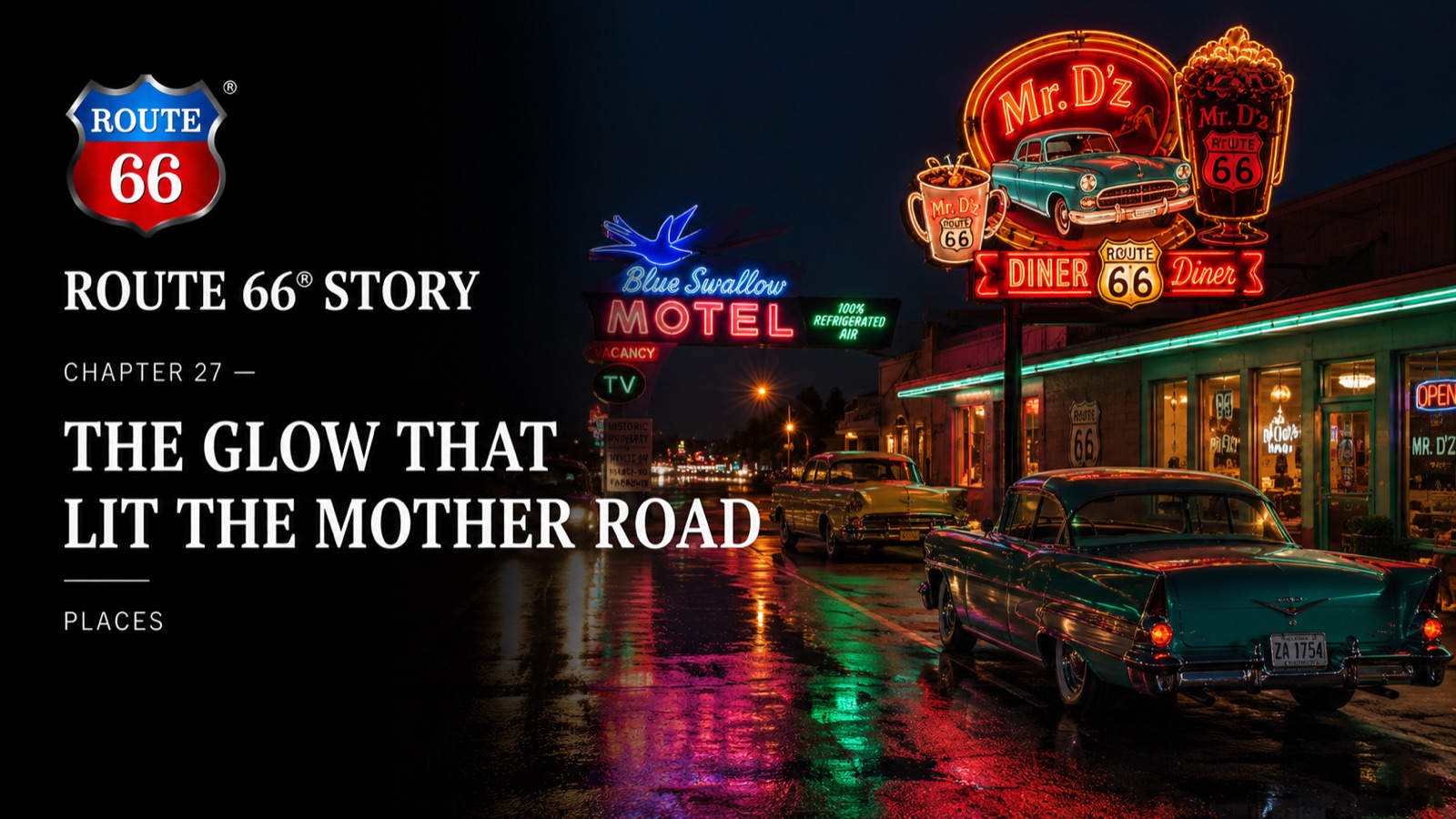
For a certain kind of traveler, the truest color of Route 66 isn’t asphalt gray or desert gold. It’s the electric red of a neon sign flickering to life at dusk.
The technology came from France. In 1910, a chemist named Georges Claude first lit a tube of neon gas at a Paris exhibition, and the glow was unlike anything the world had seen. It reached America a little over a decade later — a Los Angeles Packard dealer is widely credited with putting up the first neon signs in the country around 1923, and drivers reportedly stopped in the street to stare.
Route 66 became one of neon’s great galleries. As motels, cafés and filling stations competed for the eye of a driver doing forty miles an hour at dusk, brighter and bolder signs became a matter of survival. A swallow in blue, a cowboy tipping his hat, a giant arrow pointing at a vacancy — the whole road learned to glow.
The trick is in the gases. Pure neon burns red and orange; the blues and greens come from argon, a whisper of mercury, and colored glass. Each tube is still bent by hand, over a flame, by a dwindling number of craftsmen.
When the interstates came, thousands of those signs went dark. The ones that survived — and the ones now being relit — are the closest thing the Mother Road has to a heartbeat you can see.
The road runs on gasoline. Its soul runs on neon.
We are offering licences for ROUTE 66® Beer in specific territories. An invitation to others to become part of this story. To carry a piece of the road with them and to contribute to the story. We will share a percentage of royalties with Route 66 associations to keep the story alive.
BY ENTERING THIS WEBSITE YOU MUST BE AND CONFIRM THAT YOU ARE OF LEGAL DRINKING AGE IN THE COUNTRY THAT YOU ARE IN AND LEGALLY PERMITTED TO VIEW THESE PAGES.
This info is all part of our commitment to responsible drinking.