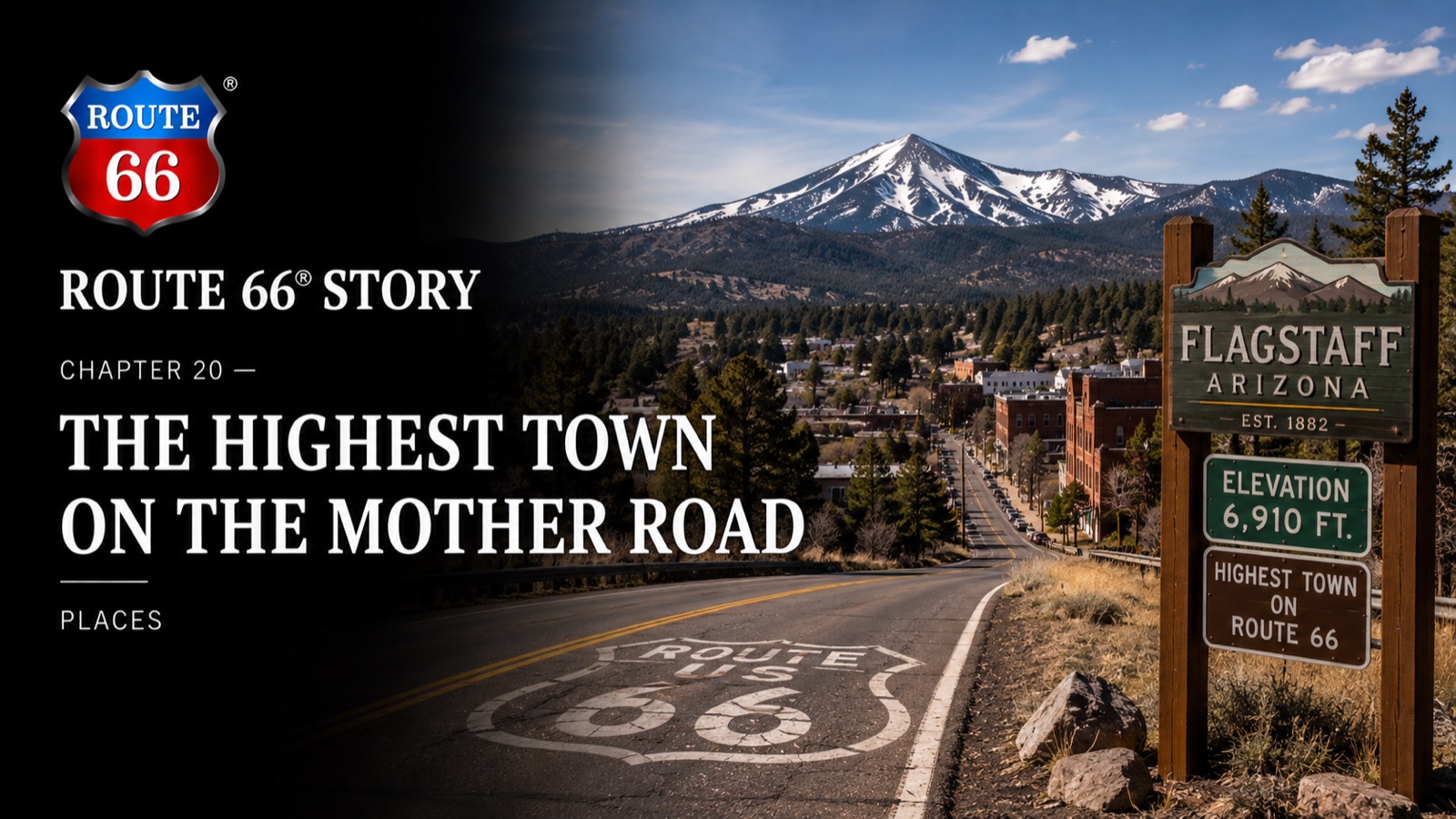
At nearly 7,000 feet, Flagstaff is the highest point any traveler reaches on Route 66 — a mountain town of ponderosa pines and thin, clear air that feels a world away from the deserts on either side of it.
It began, fittingly, with a flag. On the Fourth of July, 1876, a party of travelers stripped a tall pine and raised the Stars and Stripes to mark the nation’s centennial; the name stuck. When the railroad arrived in 1882, Flagstaff became a logging and ranching hub, and when Route 66 came through in 1926 it folded the highway straight into its downtown, where the neon and the old hotels still stand.
But Flagstaff’s most famous contribution to the world has nothing to do with the road and everything to do with the sky above it. In 1894, the astronomer Percival Lowell built an observatory on a hill west of town, drawn by the altitude and the darkness. And there, in 1930, a young researcher named Clyde Tombaugh spotted a faint moving point of light and discovered Pluto — the only planet, as it was then counted, ever found from American soil.
The clear high skies that made that possible are now protected by law: in 2001 Flagstaff became the world’s first International Dark Sky City. Drive through at night and the same darkness that revealed a planet still hangs overhead.
The road runs west toward the desert. Above Flagstaff, it runs straight up into the stars.
We are offering licences for ROUTE 66® Beer in specific territories. An invitation to others to become part of this story. To carry a piece of the road with them and to contribute to the story. We will share a percentage of royalties with Route 66 associations to keep the story alive.
Contact Us
The journey continues. This story is brought to you by ROUTE 66® BEER. Find us at ROUTE66BEER.COM