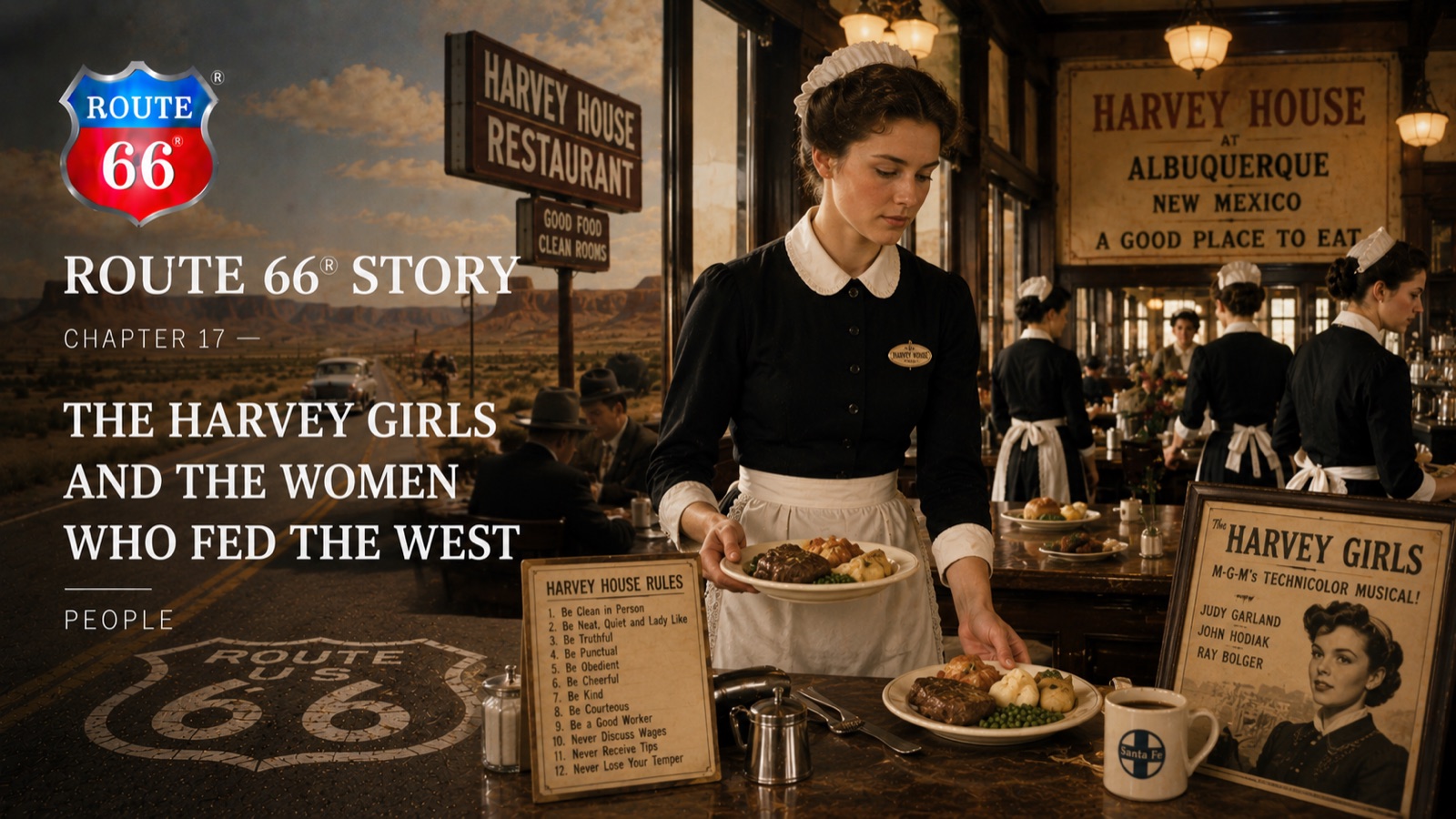
Before Route 66 carried motorists west, the railroad carried them — and waiting at the end of each hungry stretch of track was a Harvey Girl.
Fred Harvey, an English immigrant who had suffered enough bad depot food as a traveling freight agent, built an empire out of doing it better. Starting in the 1870s, his Harvey House restaurants and hotels spread along the Atchison, Topeka & Santa Fe Railway, and he staffed them with a small army of young women recruited from back East: single, of “good character,” willing to sign up for a year in a raw and distant country. By the time Harvey died in 1901, the company ran dozens of restaurants, fifteen hotels, and thirty dining cars.
The Harvey Girls arrived in starched aprons and strict rules — curfews, dormitories, no marrying during the first contract — and quietly changed the map. In towns where they were often the only unmarried women for a hundred miles, a great many of them married local men, stayed, and became the schoolteachers, shopkeepers and matriarchs of the settling Southwest. It was said, only half in jest, that they civilized the West one beefsteak and cup of coffee at a time.
When the automobile eclipsed the railroad, the Harvey company followed the traffic onto roads like Route 66. Hollywood tipped its hat in 1946, with Judy Garland in The Harvey Girls.
They came to pour coffee. They stayed to build a region.
We are offering licences for ROUTE 66® Beer in specific territories. An invitation to others to become part of this story. To carry a piece of the road with them and to contribute to the story. We will share a percentage of royalties with Route 66 associations to keep the story alive.
Contact Us
The journey continues. This story is brought to you by ROUTE 66® BEER. Find us at ROUTE66BEER.COM