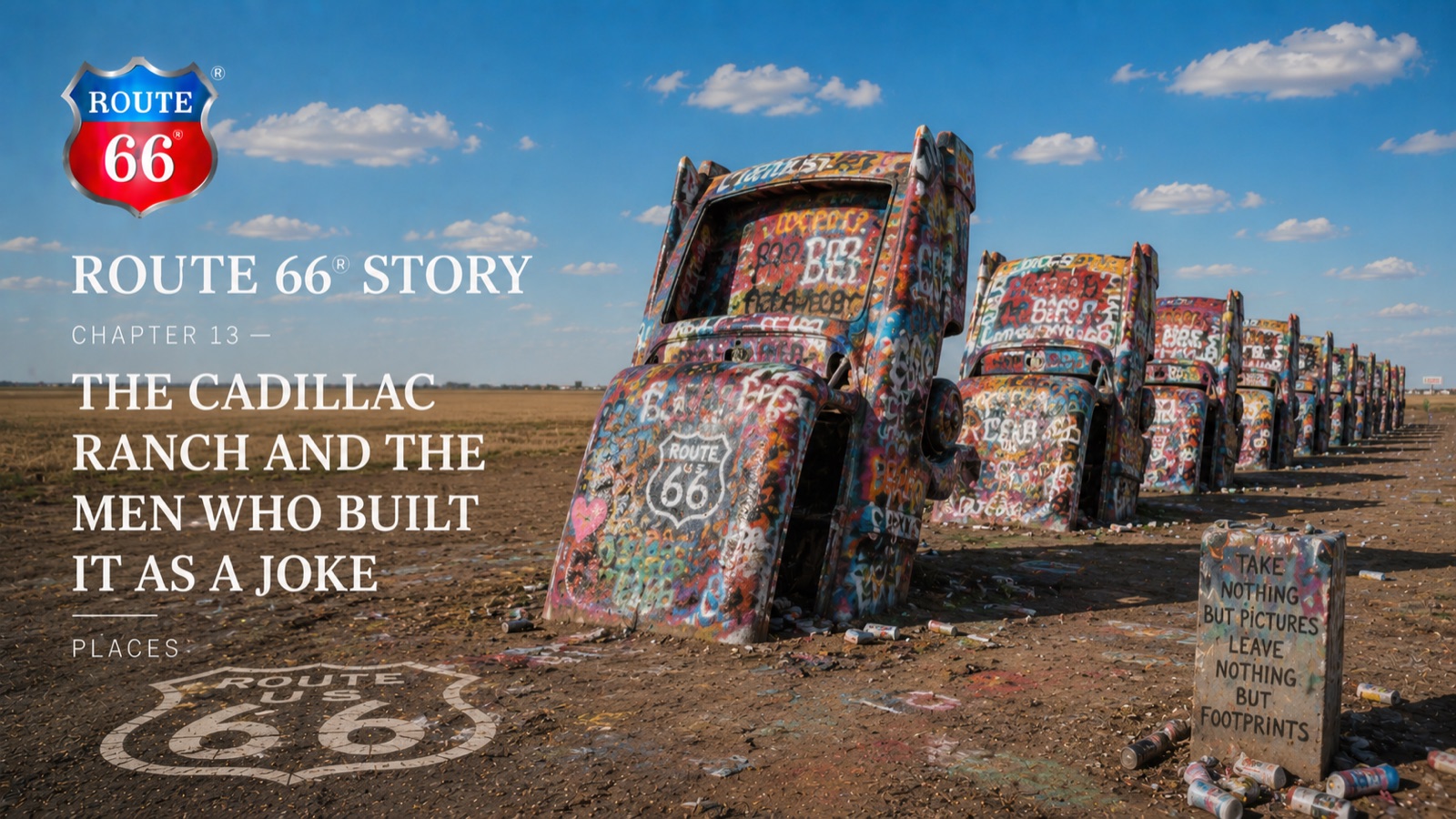
West of Amarillo, ten Cadillacs stand buried nose-first in a field, tail fins tipped toward the sky, every inch of them buried under decades of spray paint. It is probably the most famous piece of public art on Route 66, and it began as a joke with money behind it.
In 1974, a San Francisco art collective called Ant Farm — Chip Lord, Hudson Marquez, and Doug Michels — pitched the idea to Stanley Marsh 3, an eccentric Amarillo millionaire with a taste for absurd gestures. They would plant a row of Cadillacs in his field, half-buried, leaning at the same angle as the sides of the Great Pyramid of Giza. Marsh, who liked nothing better than baffling his neighbors, said yes.
They chose ten Cadillacs, models spanning 1949 to 1963, to chart the rise and fall of the American tail fin — that great chrome fantasy of postwar optimism, sprouting and then shrinking as the mood of the country changed. Then they buried them in the dirt beside the Mother Road and walked away.
The public finished the artwork. Visitors began spray-painting the cars, layer over layer, until the original colors vanished under a shifting skin of graffiti that is, in effect, repainted every single day. When Amarillo’s sprawl crept too close in 1997, the whole installation was quietly dug up and reburied two miles west.
Some monuments are carved in stone. This one is remade, in aerosol, by whoever shows up.
We are offering licences for ROUTE 66® Beer in specific territories. An invitation to others to become part of this story. To carry a piece of the road with them and to contribute to the story. We will share a percentage of royalties with Route 66 associations to keep the story alive.
Contact Us
The journey continues. This story is brought to you by ROUTE 66® BEER. Find us at ROUTE66BEER.COM